

Smart Mushroom Farming Takes Shape: From Research Idea to Field-Ready Innovation
On 22 June 2026, the Centre for Resilient Agri-Food Systems (CRAFS) at the University of Malawi continued its series of field visits to Community Actionable Research Projects for Enterprise (CARP-E) grantees, aimed at tracking progress, documenting impact, and showcasing how research-driven innovations are advancing Malawi’s agri-food systems. This visit focused on the Smart Control and Monitoring System for Greenhouse Mushroom Farming, an innovation that is steadily moving from concept development towards practical application.
The team visited the Smart Control and Monitoring System for Greenhouse Mushroom Farming, led by Dr Stanley Mlatho, which is being developed to improve the management of environmental conditions required for successful mushroom production. The system is designed to monitor and regulate key parameters such as temperature, humidity, light, carbon dioxide, and moisture, while supporting farmers with data-driven decision-making.
Implemented by researchers from the University of Malawi’s Department of Physics and Electronics, the project received a grant of US$ 7,500 under the CARP-E programme. This support has enabled the team to progress from concept and prototype stages into infrastructure development, controller finalisation, and preparation for pilot deployment.
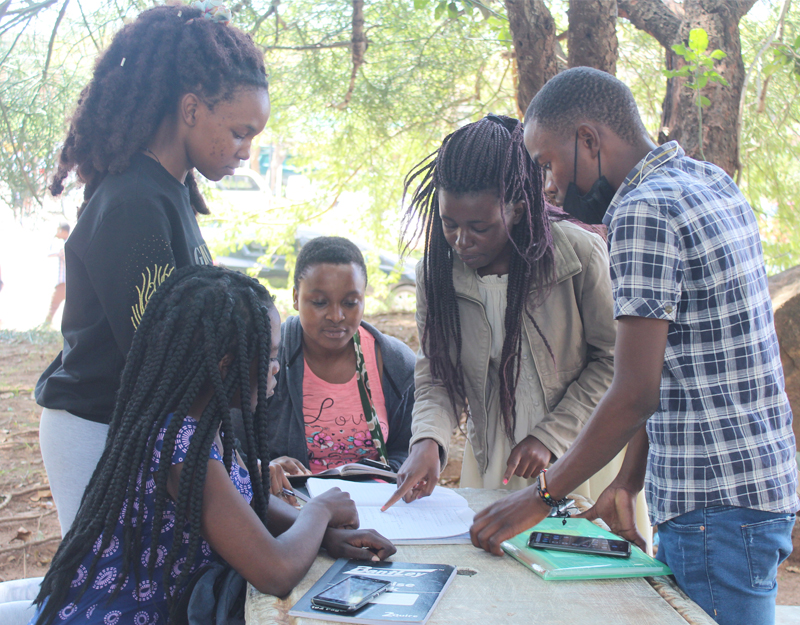
Dr Mlatho explained that CARP-E funding has been instrumental in transforming the idea into a functional system and strengthening collaboration with students while ensuring that the design responds to real farmer needs. The development process has been strongly farmer-centred, beginning with problem identification and progressing through design, procurement, and prototype integration.
The next phase will focus on installation, calibration, and field trials with farmers to refine the system based on user feedback.
During the visit, members of the CRAFS monitoring team highlighted the broader impact of the programme. Dr Dalitso Kafumbata, Deputy Academic Centre Leader, noted that CARP-E is not only supporting innovation development but ensuring that solutions directly respond to challenges faced by communities, emphasising that relevance is key to technology adoption.
Dr Elias Mwakilama, Deputy Monitoring and Evaluation Coordinator, observed that CARP-E grantees are advancing diverse innovations across the agri-food system, including smart greenhouses, value addition, and digital farming tools, many of which are now moving from early-stage ideas to practical application.
The visit reaffirmed CRAFS’ commitment to supporting homegrown innovations that bridge research and community needs, demonstrating how locally developed technologies can enhance productivity and strengthen resilient agricultural systems in Malawi.